
Apple container boundary
Apple container is the execution substrate. Hostwright sits above it and is careful about what it does and does not own.
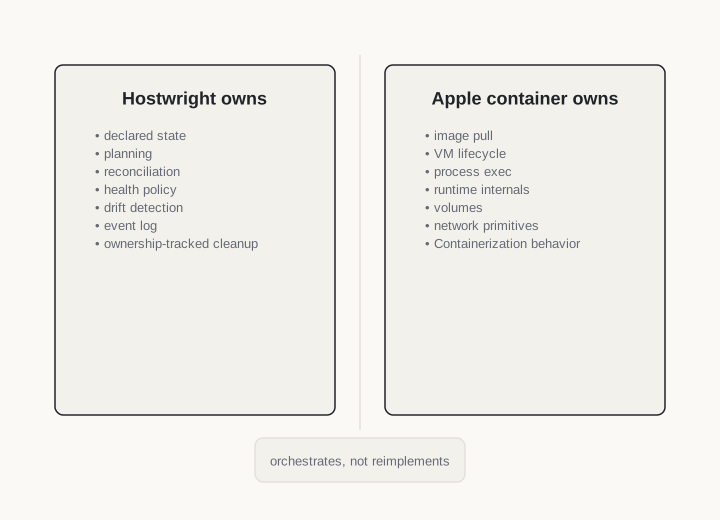
Hostwright does not run containers. Apple container runs containers; Hostwright decides what should run and keeps it honest. Understanding where that line sits is essential to understanding the project.
What Apple container provides
Apple container is a Mac-native runtime built for Apple silicon. The properties that matter for Hostwright:
- A VM-per-container model — each container runs in its own lightweight Linux VM rather than a single shared VM.
- An OCI image flow, so standard container images work.
- A command surface and helper services managed under macOS (launchd, XPC), with
vmnet-based networking.
The VM-per-container model is a defining constraint: replicas and large stacks carry real per-VM memory overhead, which shapes Hostwright’s resource guardrails.
The path of a runtime operation
hostwright CLI
  → hostwrightd
    → RuntimeAdapter
      → Apple container CLI / Containerization
        → Apple container services
          → lightweight Linux VM
            → your container process
Everything above the RuntimeAdapter is Hostwright. Everything below it is Apple’s. The adapter is the seam.
What Hostwright owns
- Declared state, planning, and reconciliation.
- Drift detection, health, restart policy, and events.
- An ownership ledger and a conservative cleanup policy.
What Apple container owns
- The container and VM lifecycle internals.
- The image store and registry interactions.
- The networking stack and system helpers.
Open questions at the boundary
These depend on Apple container behavior and are tracked, not assumed:
- The boundaries of
execand interactive attach. - Port-forwarding semantics and equivalents.
- Log streaming for short-lived containers.
- Stable MAC addresses and project-level network isolation.
- What ownership metadata the runtime can carry for owned resources.