
Runtime adapter
Every runtime operation crosses a single typed boundary, so Apple container assumptions never leak across the codebase.
The RuntimeAdapter is the one place in Hostwright that talks to the runtime. Nothing else — not the reconciler, not the CLI — calls Apple container directly. This single boundary is the most important architectural decision in the project.
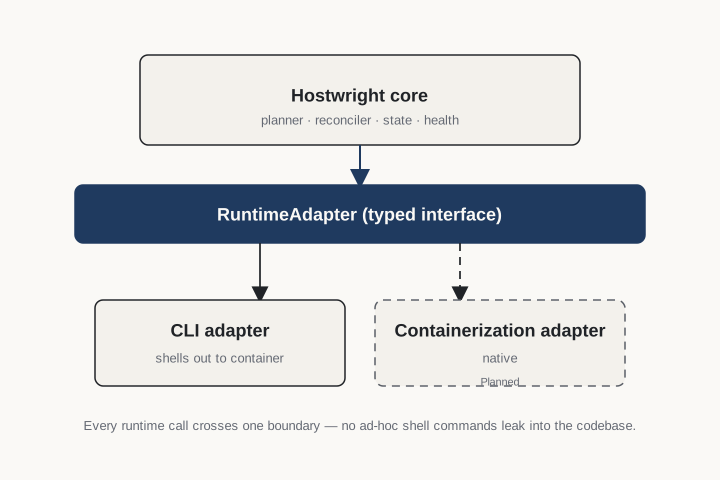
Why a single boundary
Apple container is young and evolving. Its command surface, structured output, and native APIs will change. If assumptions about it were scattered across the reconciler, the state store, and the CLI, every runtime change would ripple through the whole codebase.
By forcing every runtime operation through one typed protocol, Hostwright keeps those assumptions contained. The reconciler works against an abstract contract; it does not know or care whether the call is served by shelling out to the Apple container CLI or by a future Swift-native client.
The contract
The adapter exposes typed operations to the rest of the system — roughly:
protocol RuntimeAdapter {
    func systemStatus() async throws -> RuntimeSystemStatus
    func pullImage(_ ref: ImageReference, policy: PullPolicy) async throws -> ImageRecord
    func list(project: ProjectName) async throws -> [RuntimeContainer]
    func inspect(_ id: RuntimeContainerID) async throws -> RuntimeContainer
    func create(_ spec: ContainerCreateSpec) async throws -> RuntimeContainerID
    func start(_ id: RuntimeContainerID) async throws
    func stop(_ id: RuntimeContainerID, timeout: Duration) async throws
    func delete(_ id: RuntimeContainerID) async throws
    func logs(_ id: RuntimeContainerID, options: LogOptions) async throws -> LogStream
    func stats(_ id: RuntimeContainerID) async throws -> RuntimeStatsSnapshot
}
The exact shape will evolve, but the principle is fixed: typed inputs, typed outputs, typed errors. The reconciler never parses a human-readable table.
CLI adapter first, native adapter later
The first concrete implementation drives the Apple container CLI and parses its structured output. A Swift-native adapter built on Apple’s Containerization APIs is a later option — adopted only when that surface is stable enough to depend on. Both implement the same protocol, so the rest of the system is unaffected by the switch.
Rules for any adapter
- Use structured output (JSON) when available; never scrape human tables.
- Every subprocess call has a timeout, captured stderr, and typed error mapping.
- Every operation is cancellable.
- Operations are recorded as events without leaking secrets.
- Every observed status carries its source and a timestamp.
- Behavior is tested through a mock adapter and at least one real integration path.
Open questions
- How much runtime state can be reliably observed through the CLI’s structured output today?
- Which metadata can mark Hostwright-owned containers, volumes, and networks, versus what must live in Hostwright’s own state store?
- When does the native Containerization API become stable enough to back a second adapter?