
Why Hostwright
The motivation — a new Mac-native runtime surface, the value of local desired-state control, and the decisions that follow.
Hostwright exists because of a specific change in the Mac development landscape, and because of a gap that change leaves open.
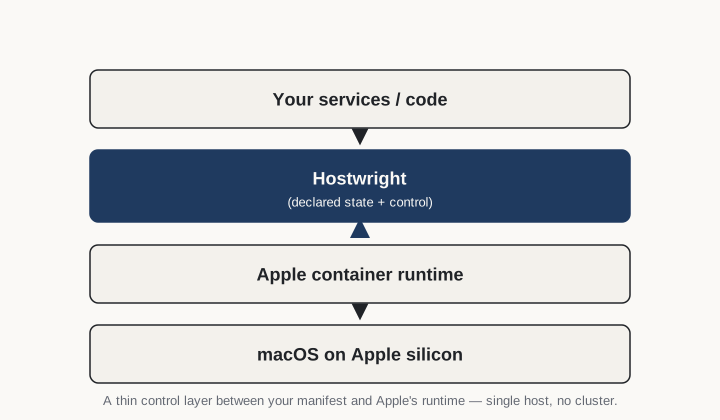
Apple container is a new runtime surface
For years, running Linux containers on a Mac meant a shared Linux VM managed by a third-party tool. Apple container changes the substrate: it is Mac-native, built for Apple silicon, and uses a lightweight VM per container with an OCI image flow.
A new runtime surface is worth building on directly rather than wrapping in older abstractions. But a runtime is not a workflow. Apple container can start and stop containers; it does not, by itself, give you a disciplined way to declare a multi-service stack, validate it, converge to it, and notice when reality drifts.
Local desired-state control is the missing layer
Most developers running a local stack end up with a pile of imperative commands and a mental model of what should be running. That model is fragile. A desired-state layer makes it durable:
- You declare the stack once.
- Changes are planned before they happen.
- Drift between declared and observed state is detected, not discovered by surprise.
- Cleanup is ownership-aware instead of best-effort.
This is the layer Hostwright provides. It borrows the idea of a control loop from systems like Kubernetes without borrowing their scope.
Why single-host first
A single Mac is a complete, honest problem. It is also the problem most developers actually have. Trying to be a cluster orchestrator on day one would mean shipping a distributed system that is shallow everywhere instead of a local system that is deep where it matters. Single-host first is a scope decision that makes the first release defensible.
Why Swift
The runtime substrate is Apple-native, so the control plane is too. Swift gives Hostwright direct access to macOS facilities — launchd, the Keychain, unified logging — and a path to Apple’s Containerization APIs without a foreign-language bridge. A Swift daemon, CLI, and core library keep the whole system in one idiomatic, testable codebase.
Why the RuntimeAdapter is the core boundary
Apple container is young and will change. The single most important design decision is to route every runtime operation through one typed boundary — the RuntimeAdapter — so that runtime change is contained to one place. It is what lets Hostwright start on the Apple container CLI today and move to a native API later without rewriting the reconciler. The boundary is the project’s insurance policy against a moving substrate.