
Name and identity
What "Hostwright" means, what the H mark represents, and the single visual motif the project allows itself.
The name and the mark both encode the same idea: shaping and maintaining the state of a local host.
The name
A wright is a maker or repairer — a shipwright builds ships, a wheelwright builds wheels. A hostwright, then, is a craftsperson of the local host: the thing that shapes, repairs, supervises, and maintains host-local container workload state.
That is precisely the job. Hostwright does not run your containers; it keeps the
host in the state you declared, repairing drift and supervising health. The name
is meant to be understood by the same people who respect systemd, SQLite, and
Apple container — serious, specific, and not borrowed from the Kubernetes or
Docker vocabulary.
The mark
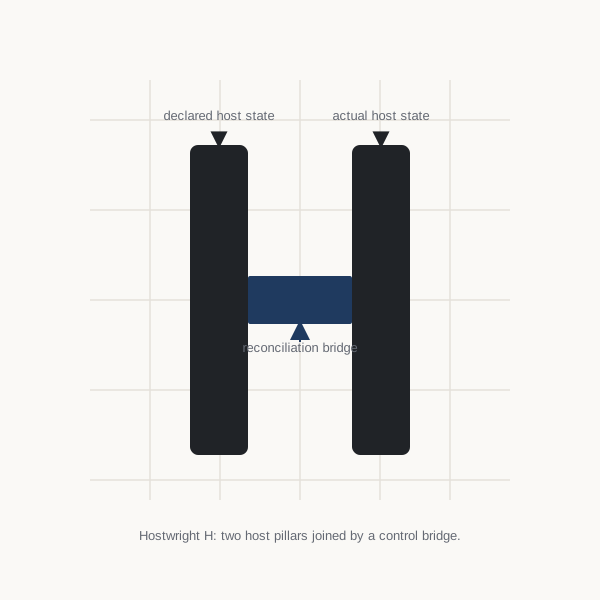
The H symbol is two host pillars joined by a single control bridge.
- The two pillars stand for the two states Hostwright always holds in mind: the declared state and the actual host runtime state.
- The bridge between them is reconciliation — the controlled connection that brings actual state toward declared state.
The mark is geometric and flat on purpose. It reads at favicon size, it works in a single ink color, and it carries the project’s one idea without ornament.
One motif, used sparingly
Hostwright allows itself exactly one visual motif: host pillars, a control bridge, a reconciliation line. It appears in the mark and, quietly, as the thin rule between sections. There are no gradients, no particles, and no decorative illustration. The restraint is the point — this is infrastructure, and the design should feel like infrastructure.
Canonical names
To keep everything consistent across the CLI, daemon, manifests, and docs:
| Thing | Name |
|---|---|
| Project | Hostwright |
| CLI | hostwright |
| Daemon | hostwrightd |
| Manifest | hostwright.yaml |
| Documentation | hostwright.dev |
Lowercase hostwright is used for the command, packages, and file names;
PascalCase Hostwright… is used for Swift modules and types. The human-facing
name is always Hostwright.